"Take much of what you have heard about how the best executives make decisions. Now, forget it." This is how The Wall Street Journal hails the new findings from neuroscience in their article "Inside the Executive Brain" by Andrew Blackman. Neuroscientists have revolutionized what we know about good decision making (according to the neuroscientists themselves anyway). So let's take a look at what these people have found and want to teach, and how they want to teach it. Are they really discovering new things or are they just reinventing the wheel? What have they discovered and what may they have missed?
Lesson 1: Deadlines can make people less creative. Pardon me, but this isn't really brain science is it? Oh, right, it is. Is anyone really surprised when they hear that people aren't the best at thinking outside the box when they are stressed and just have to get something done? At least for my wife and me, that is when we hit survival mode where we just have to get it done in the simplest way possible. Mistakes are made in such situations. According to Blackman, "Richard Boyatzis - along with another colleague Anthony Jack and others - has found that a tight deadline increases people's urgency and stress levels" (R1). Really? Wow, I never would have guessed that. Seriously, you needed to use "sophisticated machines to map what's going on inside the brain" in order to figure that out? I don't even want to know how much that study cost.

Anyway, the part of the brain that is activated is the "task positive network" which works on problem solving but does not come up with original ideas. Who knew? "The research shows us that the more stressful a deadline is, the less open you are to other ways of approaching the problem." Yes, that's when I shut all the windows, close myself to everyone, and just attempt to barrel through the problem. It leads to people not even seeing the box they are thinking inside. The solution, they say, is to teach employees to meditate more, which some were able to do before the whole tyranny of deadlines was imposed in the first place...oh well.
Lesson 2: Fear and anxiety lead to bad decisions. Wow, didn't see that one coming. Evidently, people who live in fear of losing their job or company tend to expect the worst and act accordingly, thereby often self-sabotaging or avoiding opportunities which may have saved them. Well, here's my comment:


Though he mentions that "consciously countering it by reframing an issue in more positive terms, can also be effective." (Instead of calling it a market meltdown, think about calling it a market waterfall! Ooh, I feel all warm and fuzzy inside now ;)
Lesson 3: Good leaders look past facts and lean more on emotions and intuition than logic. Ok, here I am actually learning something, although I am not too surprised. After all, there is a reason why number crunching by itself does not lead to good decisions and why we need people rather than machines in leadership positions. Researchers gave a bunch of management scenarios to experienced executives and scanned their brain as they were analyzing. What they found surprised them. According to Blackman: "They expected to see a lot of activity in the prefrontal cortex, the area of the brain known for its involvement in things like planning and logical reasoning. There was activity there, but different areas of the brain were dominant - those involved in social and emotional thinking." This disparity increased in those who were known to be the best decision makers.
Of course, part of the reason is that leaders have to consider the emotions of those they are leading. David Rock, director of the research organization NeuroLeadership Institute says that "A lot of strategies that go wrong are because managers haven't thought through what happens when it hits people" (R2) and many leaders have problems shifting between the analytical number-crunching and social modes of thinking. In other words, they have gone to business school to learn all about finance and numbers, and as leaders they struggle to relearn what they once knew about people.

A tip from Matthew Lieberman, professor of psychology at the University of California, is "simple reminders" like sticky notes to remember not to get too caught up in numbers and analysis. Getting quite advanced here, isn't it? Meditation, embracing fear, and putting up sticky notes to remember to think about people. I can definitely understand why these consultants and researchers are paid millions of dollars for their absolutely invaluable advice and insights.
Lesson 4: Good leaders are positive. Evidently, although some people somehow think you have to be a jerk to get things done, "the data says that's just not true" according to Dr. Boyatzis. So now he can stop abusing his research assistants while thinking he is doing them a favor, I guess. I can't believe how surprised Blackman sounds when he is writing this! He writes, "The best leaders, it seems, are good at motivating people with things like encouragement, praise and rewards - thereby creating a strong emotional bond and sense of purpose among employees." Wow, business gurus have finally realized that you need to be nice to people to get them to work for you. Isn't this just basic common sense? There is a reason why memes like these are so common:

What is the point? you may ask? Have I written this article just to make fun of researchers in general and perhaps neuroscientists in particular? Actually, I find this research to be valuable. Yes, it often confirms things that we already know, but it adds the weight of science and numbers to common sense. There is an increased credibility when research like this has been done, credibility which has more power to inform policy than "common sense" does. It is one thing if you have read it in a book by the likes of Dale Carnegie, and something else if it has been "proven" by science. If you have a boss who has bought into some kind of new management craze and requires tighter deadlines, puts people more on their toes, prefers number crunchers to people who are socially intelligent, and says that being negative and tough is "just his style," you now have numbers and research of your own to convince him or his superior that his approach is mistaken.
However, I do have an axe to grind against some of the neo-positivistic thinking which goes into a lot of this research which says that everything that is important can be measured and quantified. This, I think, becomes most clear of all in the feeble and vague solutions they propose for these problems: Meditate, what kind of meditation? Not all meditation is productive. Embrace your fears and become aware of them? How exactly do you do that? Put sticky notes up to remember people? Right, because all we need to change our behavior and way of thinking is another reminder in a world full of checklists and notification devices.
Most absurd of all, Doctor Waldman at Arizona State University wants to train good leaders by making them watch TV! Yes, you read it right. He claims that "We are right on the cusp of being able to assist leaders to rewire their own brains." You see, they have found that good leaders have what they call "inspirational leadership" which they define as "the ability to articulate a vision that inspires people and makes them buy into your strategy. Not only can these people see the big picture, but they can put that picture into words and impart it to others." In other words, a good leader needs to be a good speaker and communicator.
This was the goal of the entire tradition of teaching rhetoric, with successful outcomes shown in people like Pericles, Cicero, John Adams, and Winston Churchill. They learned through exercises, principles, and practice to analyze a matter, find a good solution, and then to articulate good arguments and reasons for this course of action. Some of the core skills and practices involved articulating the larger principles at stake, showing their connections to the case at hand, and making the perspective vivid and compelling. In fact, the humanities and a humanistic approach is especially suited to this training (as I argue here).

According to Waldman, I guess they have been going about it in the wrong way. The real way to teach leadership is through neurofeedback. Here is how it works: You make people watch a movie while you are monitoring their brain activity. "If the people aren't displaying the desired brain patterns, for example, the screen they're watching may go fuzzy. When they do display the right brain patterns, it becomes sharp again. Gradually, people's brains learn to follow the patterns that are positively reinforced." Come on! They think the brain will reprogram itself simply by "giving it a cookie" when it is doing the right thing? Even dogs' brains aren't that mechanistic! I know, I have trained several. With this "brainwashing" activity they really think that they will train people's brains to "make those visionary-leadership connections naturally - and, with any luck, make it easier for them to inspire people more easily."
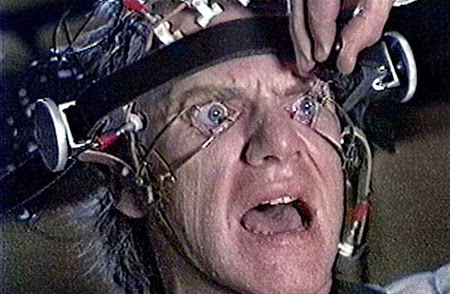
Wow, who knew that to become a visionary inspirational leader all you needed to do was to watch a TV which goes fuzzy when you think the wrong way. If only Cicero, Churchill, and Martin Luther King Jr. had known this! To think of all the hours, years, they spent listening to and giving speeches, studying the concepts, listening to people and trying to understand them, and then to find out that all they needed was a little bit of reprogramming through neurofeedback. Well, good luck Dr. Waldman. Of course, he says that neurofeedback still needs more research before researchers can be sure it will work in developing leadership ability. Guess who is going to fund that research, and guess how likely it is that he will be a recipient of government grants, stipends, and research fellowships in order to carry on with that research.
Have you heard the saying "if all you have is a hammer, everything looks like a nail"? In some ways it makes sense that if you have a machine like the fMRI-scanner which records activity and connections, the solution seems to be to rewire those connections which happen to be the problem. Yet the mind is more than just a ball of wires. I think it would be appropriate to end with a word from Kenneth Burke. He predicted that positivists will be blind to the non-mechanistic elements of human nature and reality. “The quasi-scientific reductionist theories, with their caricatures of perfection, will not only never see it in the first place, but will be so constructed that they never even miss the loss” (301). While looking for the secrets of leadership through the methods of neuroscience it seems like it is also possible for researchers to become blind to other aspects of what it means to be and become a good leader. As Kenneth Burke would say, "It's more complicated than that." Leadership is not developed in a day, and despite the short-cuts these people are promising, it takes patience, passion, and natural ability. Becoming a good leader is a lifelong pursuit.
Lesson 1: Deadlines can make people less creative. Pardon me, but this isn't really brain science is it? Oh, right, it is. Is anyone really surprised when they hear that people aren't the best at thinking outside the box when they are stressed and just have to get something done? At least for my wife and me, that is when we hit survival mode where we just have to get it done in the simplest way possible. Mistakes are made in such situations. According to Blackman, "Richard Boyatzis - along with another colleague Anthony Jack and others - has found that a tight deadline increases people's urgency and stress levels" (R1). Really? Wow, I never would have guessed that. Seriously, you needed to use "sophisticated machines to map what's going on inside the brain" in order to figure that out? I don't even want to know how much that study cost.
Lesson 2: Fear and anxiety lead to bad decisions. Wow, didn't see that one coming. Evidently, people who live in fear of losing their job or company tend to expect the worst and act accordingly, thereby often self-sabotaging or avoiding opportunities which may have saved them. Well, here's my comment:
Seriously though, is this really news to anyone but Wall Street Journal? Anyway, Srini Pillay, founder of the coaching firm Neurobusiness Group says the answer is not to avoid fear and anxiety, since they are apparently inevitable in modern workplaces. "The solution lies not in trying to avoid it, but in learning to accept it. It is important to be aware that your response is likely to be an exhaggeration." In other words: EMBRACE YOUR FEARS!
Though he mentions that "consciously countering it by reframing an issue in more positive terms, can also be effective." (Instead of calling it a market meltdown, think about calling it a market waterfall! Ooh, I feel all warm and fuzzy inside now ;)
Lesson 3: Good leaders look past facts and lean more on emotions and intuition than logic. Ok, here I am actually learning something, although I am not too surprised. After all, there is a reason why number crunching by itself does not lead to good decisions and why we need people rather than machines in leadership positions. Researchers gave a bunch of management scenarios to experienced executives and scanned their brain as they were analyzing. What they found surprised them. According to Blackman: "They expected to see a lot of activity in the prefrontal cortex, the area of the brain known for its involvement in things like planning and logical reasoning. There was activity there, but different areas of the brain were dominant - those involved in social and emotional thinking." This disparity increased in those who were known to be the best decision makers.
Of course, part of the reason is that leaders have to consider the emotions of those they are leading. David Rock, director of the research organization NeuroLeadership Institute says that "A lot of strategies that go wrong are because managers haven't thought through what happens when it hits people" (R2) and many leaders have problems shifting between the analytical number-crunching and social modes of thinking. In other words, they have gone to business school to learn all about finance and numbers, and as leaders they struggle to relearn what they once knew about people.
A tip from Matthew Lieberman, professor of psychology at the University of California, is "simple reminders" like sticky notes to remember not to get too caught up in numbers and analysis. Getting quite advanced here, isn't it? Meditation, embracing fear, and putting up sticky notes to remember to think about people. I can definitely understand why these consultants and researchers are paid millions of dollars for their absolutely invaluable advice and insights.
Lesson 4: Good leaders are positive. Evidently, although some people somehow think you have to be a jerk to get things done, "the data says that's just not true" according to Dr. Boyatzis. So now he can stop abusing his research assistants while thinking he is doing them a favor, I guess. I can't believe how surprised Blackman sounds when he is writing this! He writes, "The best leaders, it seems, are good at motivating people with things like encouragement, praise and rewards - thereby creating a strong emotional bond and sense of purpose among employees." Wow, business gurus have finally realized that you need to be nice to people to get them to work for you. Isn't this just basic common sense? There is a reason why memes like these are so common:
What is the point? you may ask? Have I written this article just to make fun of researchers in general and perhaps neuroscientists in particular? Actually, I find this research to be valuable. Yes, it often confirms things that we already know, but it adds the weight of science and numbers to common sense. There is an increased credibility when research like this has been done, credibility which has more power to inform policy than "common sense" does. It is one thing if you have read it in a book by the likes of Dale Carnegie, and something else if it has been "proven" by science. If you have a boss who has bought into some kind of new management craze and requires tighter deadlines, puts people more on their toes, prefers number crunchers to people who are socially intelligent, and says that being negative and tough is "just his style," you now have numbers and research of your own to convince him or his superior that his approach is mistaken.
However, I do have an axe to grind against some of the neo-positivistic thinking which goes into a lot of this research which says that everything that is important can be measured and quantified. This, I think, becomes most clear of all in the feeble and vague solutions they propose for these problems: Meditate, what kind of meditation? Not all meditation is productive. Embrace your fears and become aware of them? How exactly do you do that? Put sticky notes up to remember people? Right, because all we need to change our behavior and way of thinking is another reminder in a world full of checklists and notification devices.
Most absurd of all, Doctor Waldman at Arizona State University wants to train good leaders by making them watch TV! Yes, you read it right. He claims that "We are right on the cusp of being able to assist leaders to rewire their own brains." You see, they have found that good leaders have what they call "inspirational leadership" which they define as "the ability to articulate a vision that inspires people and makes them buy into your strategy. Not only can these people see the big picture, but they can put that picture into words and impart it to others." In other words, a good leader needs to be a good speaker and communicator.
This was the goal of the entire tradition of teaching rhetoric, with successful outcomes shown in people like Pericles, Cicero, John Adams, and Winston Churchill. They learned through exercises, principles, and practice to analyze a matter, find a good solution, and then to articulate good arguments and reasons for this course of action. Some of the core skills and practices involved articulating the larger principles at stake, showing their connections to the case at hand, and making the perspective vivid and compelling. In fact, the humanities and a humanistic approach is especially suited to this training (as I argue here).
Wow, who knew that to become a visionary inspirational leader all you needed to do was to watch a TV which goes fuzzy when you think the wrong way. If only Cicero, Churchill, and Martin Luther King Jr. had known this! To think of all the hours, years, they spent listening to and giving speeches, studying the concepts, listening to people and trying to understand them, and then to find out that all they needed was a little bit of reprogramming through neurofeedback. Well, good luck Dr. Waldman. Of course, he says that neurofeedback still needs more research before researchers can be sure it will work in developing leadership ability. Guess who is going to fund that research, and guess how likely it is that he will be a recipient of government grants, stipends, and research fellowships in order to carry on with that research.
Have you heard the saying "if all you have is a hammer, everything looks like a nail"? In some ways it makes sense that if you have a machine like the fMRI-scanner which records activity and connections, the solution seems to be to rewire those connections which happen to be the problem. Yet the mind is more than just a ball of wires. I think it would be appropriate to end with a word from Kenneth Burke. He predicted that positivists will be blind to the non-mechanistic elements of human nature and reality. “The quasi-scientific reductionist theories, with their caricatures of perfection, will not only never see it in the first place, but will be so constructed that they never even miss the loss” (301). While looking for the secrets of leadership through the methods of neuroscience it seems like it is also possible for researchers to become blind to other aspects of what it means to be and become a good leader. As Kenneth Burke would say, "It's more complicated than that." Leadership is not developed in a day, and despite the short-cuts these people are promising, it takes patience, passion, and natural ability. Becoming a good leader is a lifelong pursuit.

